Editorial
His radiance keeps increasing
As he fades away in time and space.
(János Arany)
|
The 155th birthday of József Fodor a pioneer contributor to Central
European hygiene
Zoltán Virágh, MD
Fodor József National Centre of Public Health
(Director General: Prof. György Ungváry, MD, Ph.D., D.Sc)
1097 Budapest, Gyáli u. 26.
HUNGARY
CEJOEM 1998; 4(3):211-213
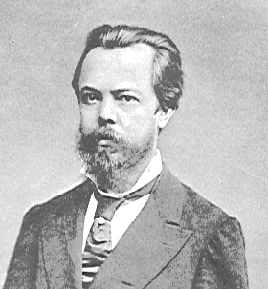 The
founder of Hungarian public health, one of the best known European hygienists
of his age was born 155 years ago.
The
founder of Hungarian public health, one of the best known European hygienists
of his age was born 155 years ago.
At the beginning of his career, he was highly affected
by the progress achieved by Edwin Chadwick and John Simon in the field
of hygiene in England.
His two-year study trip was a decisive factor for
his whole life. He got acquinted with the well developed health culture
of England and Europe and with the up-to-date hygienic research work performed
by Pettenkoffer in Munich, by Liebig in Giessen and by Recklinghausen in
Würzburg already at an early age. Attending the then already regularly
organised International Public Health and Demographic Congresses he was
very impressed by the discussions and talks with the most exceeding professionals
of his time. Some other outstanding personalities of the age were beside
the above-mentioned ones the Germans: Buchner, Rubner; the Frenchmen:
Laveran, Chantemesse, Roux, Nocard, Bertillon; the Americans: Vaughan;
the Englishmen: Lister, Adami, Hunter, Watson, Cheyne, Sherrington, Hankin;
Gruber from Vienna; Hueppe von Prague; Cunningham from Calcutta; Erismann,
Metchnikoff and Filatov from Russia and several more well-known medical
scientists.
Major milestones in Fodors life:
| 1843 |
Born on 16th July in Lakócsa, county Somogy,
Hungary, Europe |
| 1865 |
Obtains his degree in medicine at the University
of Budapest |
| 1869 |
Is qualified as privatdocent in the University
of Budapest |
| 1870 |
Obtains scholarships for study trips in Germany
and England |
| 1872 |
Is appointed professor of hygiene in the University
of Kolozsvár |
| 1873 |
His book: Public health in England, with regard
to the situation of medicine, health regulations, forensic medicine and
the conditions in Hungary is published and awarded with a 200 gold coins
prize of the Hungarian Academy of Sciences |
| 1874 |
Is appointed professor of public health in the
University of Budapest |
| 1876 |
Act on Public Health (No. 1876:14) |
| 1882 |
Further, longer study trip in England, France, Belgium, the Netherlands,
Germany, Switzerland, Italy, Greece and Turkey
Is awarded by the great gold medal of Empress Augusta Victoria for his
instruments serving for experiments in the field of hygiene, presented
at the Medical Exhibition, Berlin
Starts training courses for school doctors during the summer holidays
|
| 1883 |
Is elected associate of the Hungarian Academy
of Sciences |
| 1884 |
Designs a program for the education of school
doctors and teachers of health |
| 1885 |
Start of his researches about the bactericidal property of blood
Is elected member of the Hungarian Academy of Sciences
|
| 1886 |
Foundation of the National Society of Public
Health (Secretary General of the society till 1893) |
| 18891891 |
Gets appointed dean of the Faculty of Medicine |
| 1891 |
Is elected honorary doctor of the University
of Cambridge |
| 1893 |
Writes the chapter dealing with the hygiene of
soil in the book of Theodor Weil Handbuch der Hygiene |
| 1894 |
Vice-chairman of the International Public Health and Demographic Congress,
Budapest
Gets decorated with the Order of the Iron Crown by HM the King
|
| 18941895 |
Is elected Rector Magnificus of the University
of Budapest |
| 1895 |
Is elected an associate of the Italian Society
of Hygiene |
| 1896 |
Is elected a honorary member of the Helsinki
Society of Hygiene |
| 1897 |
Becomes honorary/ordinary member of the following
societies:
Gesellschaft für öffentliche Gesundheitspflege (Berlin)
Verein für öffentliche Gesundheitspflege (Frankfurt a.M.)
Sanitary Institute of Great Britain (London)
Society of Medical Officers of Health (London)
Società dIgiene Fiorentina
Reale Società Italiana dIgiene (Milano)
Association Internationale pour le Progrès de lHygiène (Bruxelles)
Sociedad Espagnol de Higiene (Madrid)
Finnish Society of Hygiene (Helsinki)
Société Royale de Médicine Publique (Bruxelles)
Société Française dHygiène (Paris)
Is rewarded by honorary membership and the great golden medal by the Academy
of Naples
Is elected honorary member to the Royal Academy of Belgium
|
| 1900 |
Gets decorated with the Order of Saint Sava |
| 1901 |
Is recommended by the Hungarian Academy of Sciences
for the very first Nobel prize in medicine but in the competition he cannot
take part any more |
| 1901 |
Dies unexpectedly on 20th March, at the age of
58 |
Even 100 years later, the up-to-dateness and foresight of József
Fodor is not only significant but also much-to-be-admired.
E.g.:
-
the collection and evaluation of statistical data, the importance of informatics
in
-
health science;
-
the application of the unity of exact, scientific working method and its
testing
-
in practice;
-
the sound bases of his precise, experimental hygienic researches;
-
his up-to-date microbiological and epidemiological testing methods;
-
the brilliancy of his immunological researches;
-
his practical, public health-epidemiological activity ranges:
-
from courses for school doctors to the teaching of hygienists;
-
from the vividness of university lectures to the 1876 years Public Health
Act (which belonged to the most up-to-date ones in the world and which
was a well working Health Act in Hungary for nearly 100 years!);
-
from a plan of a central observation site to the reform of the education
of medical officers;
-
from social-hygienic methods to public activity with the ability of being
a wonderful public speaker.
All the above may serve as model and example for the
present, too.
Out of Fodors several pupils the following ones
deserve to be mentioned: Aladár Rózsahegyi, Gusztáv
Rigler, Aladár Aujeszky, Ödön Frank, Zsigmond Gerlóczy,
Victor Bábes and the Japanese, Kitasato; all became professor on
the several territories of hygiene of the 20th century when that hygiene
has been differentiating more and more.
...If it is true, that small nations are lifted
up in the political arena of the world by great men, then József
Fodor deserves a very eminent place even in this relation among the sons
of the Hungarian people. ... (Prof. J. Melly, 1957.)
In 1998, the National Public Health Centre was formed
from the following institutes: National Institute (NI) of Work- and Occupational
Health, NI of Chemical Safety, NI of Environmental Health, NI of Food and
Nutritional Health and Fréderic Joliot-Curie NI of Radiation Biology
and Radiation Health. As workers of that Centre, we feel highly honoured
by adopting József Fodors name after the reorganisation of those
public health institutes which he was dreaming of for so many years.
| Back |
Posted: 18 November 1998